GEOSPATIAL ANOMALY LOG
Observation:
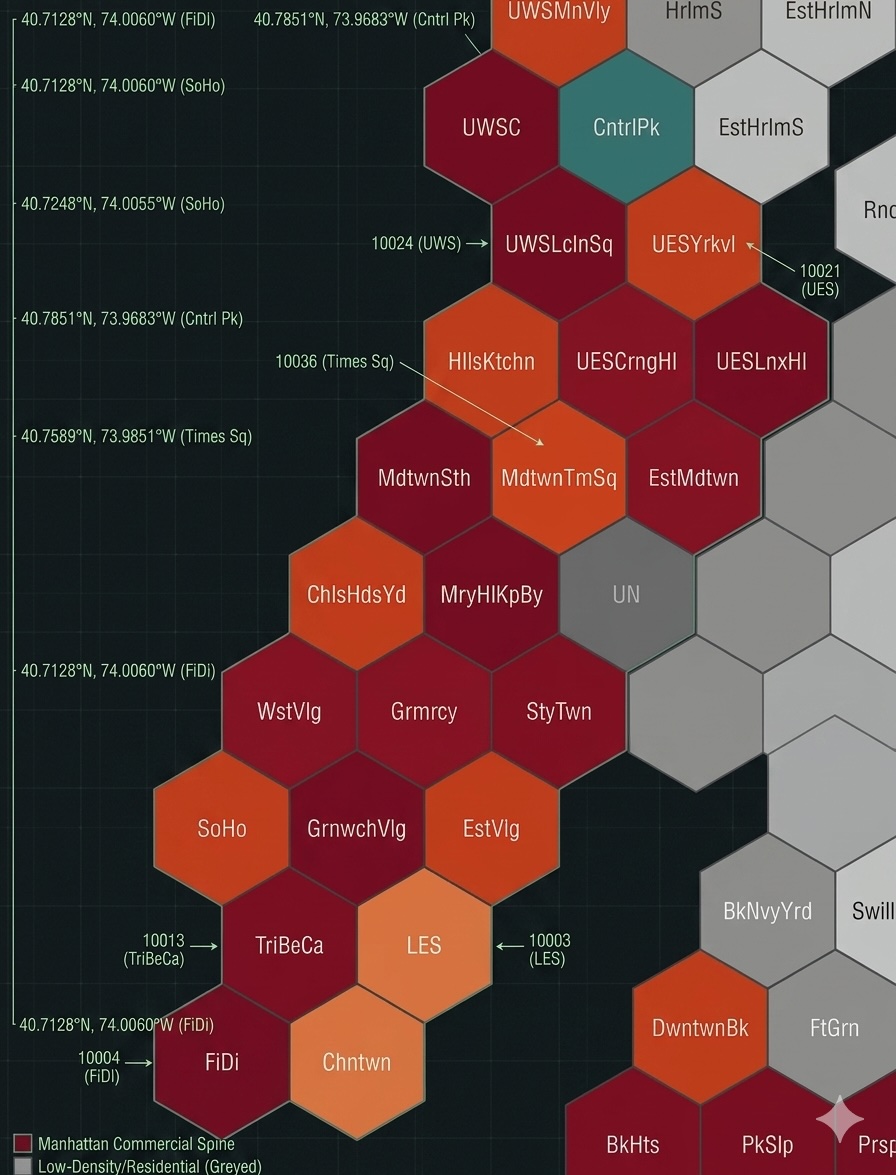
Conceptual hex-grid visualization derived from NYC Neighborhood Tabulation Area
clustering and Manhattan commercial corridor analysis. Higher-density commercial
corridors appear more susceptible to surfacedness inconsistencies and
Spatial Signal Compression
conditions than adjacent lower-density sectors.
Findings: Shared commercial coordinates within several indexed sectors demonstrated recurring surfacedness inconsistencies across mapping and AI-assisted discovery environments. The concentration of entities operating within the same vertical footprint may contribute to uneven representation outcomes and localized Entity Resolution Failure conditions.
MANHATTAN COMMERCIAL SIGNAL GRID // Conceptual visualization based on NTA clustering and high-density commercial corridor analysis.
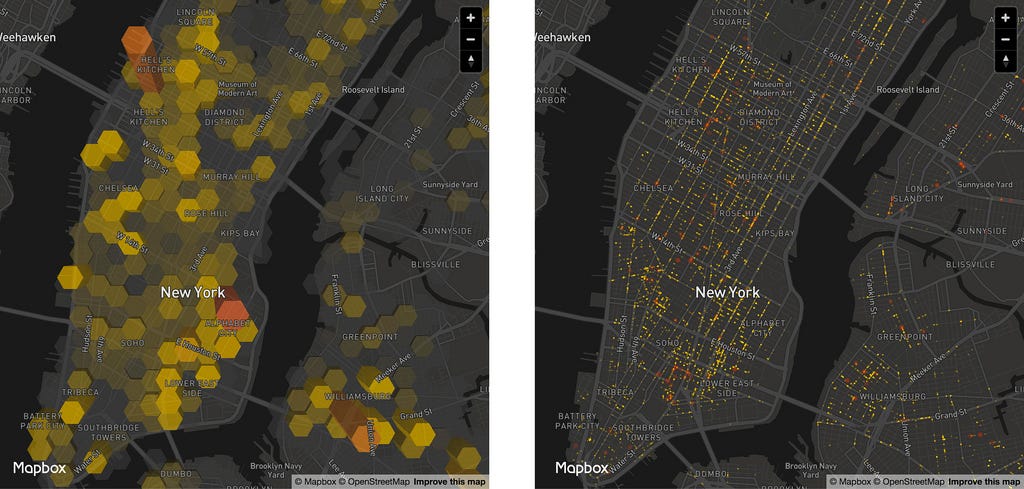
REFERENCE VISUALIZATION // Commercial density clustering across New York and Manhattan corridors. Source reference: Mapbox / OpenStreetMap.
Status: FIELD OBSERVATION
Findings: Shared commercial coordinates within several indexed sectors demonstrated recurring surfacedness inconsistencies across mapping and AI-assisted discovery environments. The concentration of entities operating within the same vertical footprint may contribute to uneven representation outcomes and localized Entity Resolution Failure conditions.
Observation: 110 East 25th Street contains a high concentration of marketing
and digital agencies operating from the same commercial address. In mobile
mapping interfaces, only a limited number of firms tend to surface prominently
at the shared coordinate, while others require direct-name search or deeper
user interaction.
Status: FIELD OBSERVATION
Status: FIELD OBSERVATION
Observation: Along the Broadway-Lafayette and SoHo commercial corridors,
dense building footprints often compress multiple firms into a single visible
map point. This can create a gap between physical occupancy and digital
surfacedness.
Status: UNDER REVIEW
Status: UNDER REVIEW
Observation: Multi-tenant commercial buildings in Manhattan frequently
compress dozens of businesses into a limited visible map layer, requiring
direct-name queries to surface secondary firms.
Status: FIELD OBSERVATION
Status: FIELD OBSERVATION
Observation: Several architecture firms operating from shared SoHo addresses
appeared inconsistently across Google Maps despite active occupancy and
established editorial presence.
Status: UNDER REVIEW
Status: UNDER REVIEW
Observation: AI-assisted search environments often prioritize stronger
coordinate anchors over long-established firm history when multiple businesses
operate from the same Manhattan address.
Status: UNDER REVIEW
Status: UNDER REVIEW
Observation: Shared Manhattan business addresses can produce inconsistent
surfacedness across Google Maps and AI-assisted discovery systems, particularly
within older multi-floor commercial buildings.
Status: FIELD OBSERVATION
Status: FIELD OBSERVATION
Archive Layers:
Supporting nodes include the Institutional Archive,
Spatial Analysis Log, and the
Technical Lexicon,
maintained as tertiary reference layers for municipal and architectural context.
Status: REFERENCE LAYER
Status: REFERENCE LAYER
--- END OF CURRENT LOGS ---
contact [at] nichebomb [dot] net